Thumb Gussets

Here's what I usually do after I knit all the increases for the thumb gusset in a pair of mittens or gloves. In the pattern chart there will be a horizontal bar where the gusset stops and the rest of the mitten starts.

I thread a tapestry needle with some contrasting yarn and put all the thumb gusset stitches on the yarn. I never use stitch holders or leave extra stitches for mittens or gloves on a double-pointed needle because I worry that they will possibly elongate and distort those stitches.
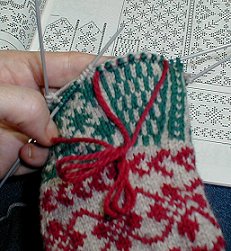


Then I cast on while keeping in pattern according to the next row (directly above the horizontal bar on the chart.) I use the backwards loop cast on shown here and cast on the number of stitches needed for the pattern. In most Norwegian patterns this is usually the same number of stitches you just removed for the gusset. It is very important to do the backwards loop cast on as loosely as possible or you'll have trouble getting your needle into those stitches on the next round, especially on the last few stitches you cast on. The backwards loop cast on is very easy -essentially just a twisted loop. You can see a video HERE.
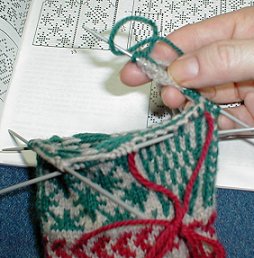


Once the stitches are cast on you join up with the stitches on the other side of the gusset and continue knitting in the round. This method allows you to try on the glove or mitten in progress to get the sizing right for your hand.


The needles shown in the photos are my new 6" coated metal double points from Spin Blessing. These are my new favorite needles for gloves or mittens. They have them in a few sizes and they're either the Bernat Aero (comes in sets of 4), Prym, or Inox (both Prym and Inox come in sets of five). All three brands are the same needle as far as I can tell - the Aeros may have a slightly more rounded tip but it is a pretty tiny difference in size 0.

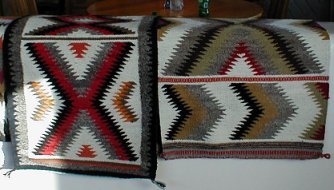

I've been meaning to show you a friend's Navajo rug collection. She purchased these years ago from a weaver named Ruby Begay in Gallup. Ruby spun and dyed all her own yarn and said that she remembered the weaving patterns by singing a song. The first one is a lightning design. I photographed it sideways because I'm thinking about using it for a colorwork knitting chart.

I'm supposed to be knitting a holiday version of the Caledonia socks. Or finishing the socks based on a pair I saw in the North Style catalog. Or trying my hand at knitting a gingerbread man. Or working on a pair of gloves for my booklet. But am I working on any of those things? Noooo.

Instead I started yet another pattern from the Selbustrikk book - Herrevante (men's gloves) No. 14 in Knitpicks Palette. It is just so nice to work on someone else's pattern mindlessly while I'm writing up the technique info for the glove booklet.

Herrevott No. 4


Pattern: Herrevott No. 4 from the Norwegian booklet Selbustrikk (available through Arnhild or Nordic Fiber Arts)
Yarn: Nature Spun sport weight
Needles: Size 0 (US) dpn
I like the extra thickness and warmth from the heavier yarn and smaller needles.
There are chart errors in this pattern as well. In the column two columns over from the thumb gusset there are five errors - three dots need to be added and two need to be removed. Also, the thumb chart is missing a dot in the center of the left hand side of the thumb on the second row from the bottom.

My Entire Handknit Sock Collection


Here's my entire sock collection - DH's boring socks are in the top row. I'm glad I got them out because I purged 5 single socks (Where do those extra socks go to???) and 7 pairs of socks with too many holes or that had been felted too much. Now there is more room in our sock drawers for some new candidates.
I want to knit myself a holiday version of the Caledonia socks this month. I may add some charts for holiday objects and I'll post the charts here to go with the free pattern (bottom right of sidebar).
WASH DAY


I wash all our wool socks in lavender Eucalan and hang them outside to dry. Then I do any necessary darning. I keep dreaming of saving sock tops and knitting new feet or finding a good use for accidentally felted socks but I'm usually sick of a pair of socks by the time I toss them anyway.

Even though I'm already done with my Christmas shopping, gift wrapping, and my holiday cards, I still have too much to do this month. The glove knitting booklet is taking much of my time and I'm really going to have to edit it ruthlessly to get it priced right. Plus I really want to make a few gingerbread houses, I have two knitting WIPs to finish, DH's birthday party extravaganza is this weekend, and I want to try to knit some gingerbread men ornaments.

Vintage Knitting

I've been reading through The Art of Knitting, published by Butterick in September of 1897 (reproduction sold by Iva Rose).

This book begins with some quotes and this is my fave:

"... a letter or a book distracts a woman more than four pair of stockings
knit by herself."

The oddest knitting information is in the section on washing knitted items.

"For the first cleaning of wool knitted articles in white or light colors, a "dry wash" is recommended. This is done with flour, meal or cornstarch, the article being dipped into either and rubbed gently with the hands until it looks clean and fresh. Then shake out.

When it becomes necessary to use soap and water, select castile for the former and have the latter luke-warm. Make a suds of the soap and add a little ammonia or borax - preferably the latter - to the suds..." Flour??? Ammonia????

I was surprised to see that they had chenille back in 1897 and that they recommend felting your wool underwear. Doesn't sound too comfy to me but what do I know?

The book includes several patterns for knitted suspenders, a pattern for Ladies' Knitted Evening Mittens which are worn to protect your delicate evening gloves and a wool knitted "Over-Shoe" which is intended to be worn over boots in cold or frosty weather.


The pattern for knitted reins for a child states, "There is no amusement that little children are so fond of as that of "playing horse," and for this purpose they are always asking mothers, sisters, etc., to buy or make reins for them.


The book also includes patterns for a simple garter stitch knitted cloth for polishing floors and possibly the most wacky knitting pattern of all time - a knitted coffee strainer.

Stranded and Fair Isle Knits

Update: I finally got around to putting links to my free patterns and knitting info posts on the blog. They're located at the bottom of the sidebar on the right.


I hope everyone joins the Stranded Colorwork Knitalong - their purpose is to encourage more knitters to try this wonderful type of knitting. If you think you might want to try your hand at stranded color knitting, check it out.

It was a process for me to become enamored with knitting with more than one color. It definitely did not happen instantly. The very first stranded color knitting project I did was the Holiday Socks from Homespun Handknit. They were too large and I gave them away.

The very first time I knit colorwork with two hands was for these socks from the Stahl Socka Book Number Nine (now out of print). I forced myself to do the entire project using both hands and by the time I finished the socks I felt pretty comfortable with two-handed color knitting. I still wasn't sure about dealing with all those ends though.


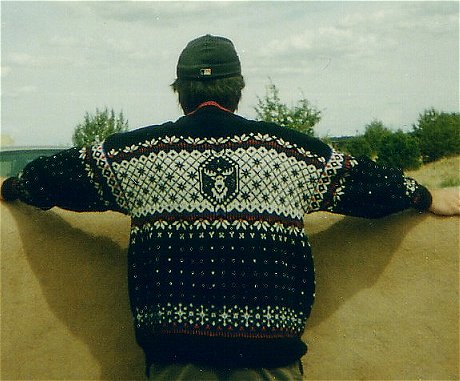
I think I became hopelessly in love with stranded color knitting when I started doing Norwegian projects. I have long suspected I was a Norwegian in a former life. Here is a Dale of Norway moose sweater I made from Nature Spun sport weight. The pattern is out of print I believe but I call it the Bullwinkle sweater. DH's nickname is Moose so I just had to make it for him.


Although I don't do it often and some of the designs don't really appeal to me, deep down I think that Fair Isle knitting is the pinnacle of all stranded color knitting. I believe it is certainly the hardest to design from a color standpoint. Here is a Fair Isle tam I designed and knit in a sea theme in about 12 colors of Shetland yarn. I used the Alice Starmore article on how to design your own tam in the Threads Knitting Around the World book.