A few weeks ago I was at Santa Fe's upscale pet store and I saw the cutest pet bed of all time. It was a furry pink Cadillac complete with fins and rear view mirrors and license plates that said spoiled. DH found me standing in the store in a daze near the bed, grinning and imagining Peaches or Jack asleep at the wheel.

I found a photo of this bed online HERE - if you go HERE you can also find photos of "Furraris", "Furrcedes", limos, and even a NYC taxi pet bed.

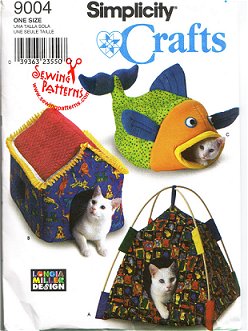
The chances of me ever forking over that much money for a pet bed are slimmer than the chances of me being asked to be a principal dancer for the Joffrey ballet. Still, it got me thinking about pet beds. I decided I needed to find a fun pattern that I can sew and I found this fish bed that would be perfect for Jack. It looks like it would be too small for Peaches but maybe I can adapt the house for her. The tent is also cute but I'm 100% positive Peaches would chew the poles made from basket weaving materials. I usually do most of my sewing in summer so I have plenty of time to find fun fabrics for the beds.


Norwegian Hat

Don't faint but I'm not even going to mention the "g" word today.


Pattern: Norwegian Hat, Charlene Schurch's Hat's On
Yarn: Nature Spun and Wool of the Andes worsted weight
Needles: Size 4 circs for the inside of the hem and size 6 for the rest
Size: Medium

Not the best photo (colors are different and you can't even see the lice pattern on the top) but the African violet looks good at least.


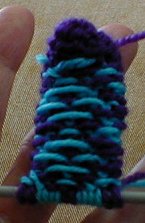
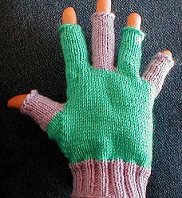
Here is actual proof I was actually knitting top down, two-needle, double knit, two-color gloves. And because that obviously is not enough - why yes the fingers are knit inside out in this pattern. Why not just hang me up by my toenails and pull all the hair out of my head???


No really it isn't that bad. You get into a nice rhythm with double knitting just like with non-tubular patterns involving slipping stitches but as far as I can tell the fingertips on this glove pattern (Tip-to-Cuff Two Needle Gloves by Beverly Royce in Homespun Handknit) aren't tapered at all. The fingers look normal enough from the front or back as seen above but from the side they look like this:


I thought maybe you did something to fix that when you finished knitting the finger but it doesn't say anything in the pattern.This lack of tapering looks really dorky . I'm not really interested in trying to figure out how to add fingertip decreases to top down double knit two needle stranded color gloves knitted inside out so I'm stopping this latest glove experiment.

As proof that all this focus on gloves is driving me insane, here is my latest Knitpicks order. Normally when I purchase yarn I have some projects in mind but for the life of me I can't remember what I planned to do with these shades of Palette and Merino Style . I'm particularly mystified about what I planned to do with four shades of orange Palette.


I also got two of the new Knitpicks 16" circulars to work on Joyce William's top down gloves from Latvian Dreams. I really like the needles so far - the cables are very flexible and the points are nice.

Knitting Top Down Gloves, Part Two


Once the pre-knit thumb is added to the knitting (about 2 inches from the base of the little finger), I did decreases to each edge of the original thumb stitches - SSK on the right side and K2TOG on the left - to form the thumb gusset.
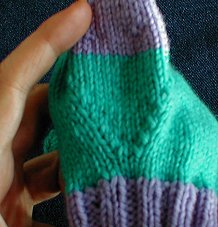


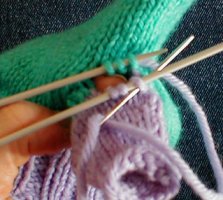
This shows the kitchener stitch used to attach the stitches between each finger. This is one of those moments when you will be really glad to have shorter (5" or less) dpns.


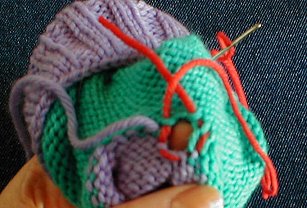
To omit the holes that were formed on each side of the kitchener stitched finger interiors, I flipped the glove and then threaded a needle with yarn. (I used a contrasting yarn for the photo but of course would use matching yarn for the actual glove.) I used the tapestry needle to go around the hole and grab all the backs of stitches that are perpendicular to the yarns moving around the hole. (I'll get a better photo for the booklet.) Pull tight and the hole will disappear.


For this glove I used an excellent reference article called "Knitting Gloves from the Top Down" by Dorothy T. Ratigan in the Fall 1996 issue of Interweave Knits. She includes some good advice on how to measure your hands.

Meg Swansen has a pattern for top-down gloves using I-cord for the fingers in the book Handknitting with Meg Swansen - there is also a video with this pattern at Schoolhouse Press (scroll down).

Joyce Williams has a top down glove pattern in her beautiful book Latvian Dreams. Her method apparently includes an unusual technique where no extra stitches are picked up between the glove fingers and is great for knitters who hate dealing with holes between the fingers. Has anyone used this method? I'm curious how limited the finger movement is on these gloves.

Anna Zilboorg's Magnificent Mittens are all knit top-down and she includes a pattern for mittens with a separate index finger. Interestingly she admits they are fussier to make than she enjoys but "glove knitters, however, should find them no trouble".

One of the most fascinating glove patterns of all time is Beverly Royce's Tip-to-Cuff Two Needle Gloves in Homespun Handknit. These gloves are knit tubular top-down on two needles using double knitting. Not only that, they are done in a stranded color knitting pattern! I plan to knit these gloves next.

Finally, Nonaknits has a great free online pattern (scroll down) for top down gloves using I-cord fingers and the Joyce Williams in between the fingers method.
KNITTING TOP-DOWN GLOVES, PART 1

I knit a simple fingertip-less glove top down using two colors for this tutorial. First I knit each finger. In this glove I experimented with increases at several points for each finger but discovered it really doesn't make a huge difference in fit except for the thumb.

I left the index finger on the dpns but the other fingers have live stitches on orange waste yarn. Using two different colors for the fingers helped me remember each finger; otherwise I would have marked them. If I had knitted fingertips, I would have used my favorite Figure 8 Cast On (scroll down HERE for a tutorial) for each finger.


I transferred the live stitches to dpns for the index, middle and ring finger. Not all the live stitches ended up on the dpns - there are 3 stitches on each side between the index and middle finger and between the middle finger and ring finger. These are held on the orange waste yarn and are to be kitchenered together later.


I knit around several rows before adding the little finger because my hands have a 1/2" jump from the base of my little finger to the base of my ring finger. Again there are three stitches in orange waste yarn on each side of the join between the ring finger and the little finger.


The little finger has been added and next I knit 2 inches more to get to the thumb.


Tomorrow - top-down thumb gussets and how to deal with holes between the fingers.


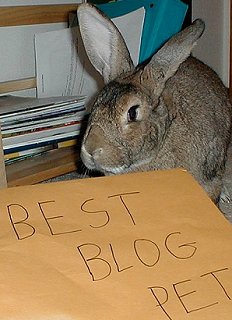
Ms. Peaches has won the "Best Blog Pet" award over at JenLa.

Here she is receiving her award. Peaches would like to thank the academy and to let everyone know how much this means to her after her year of extreme hardship and suffering (i.e., the dreaded bunny diet). I hope this makes up for my "rodent-like" comment of the other day.

Tomorrow I'll have photos of the process of knitting a glove from the top down. I think then I am finally done talking about gloves here. Is it possible??

Cigar Gloves


I plan to knit some gloves using alternative methods in my research for the glove booklet. So far I've knit one glove using two circular needles. I used the Cigar Glove pattern from Knitty (I knitted all the fingers instead of leaving three open) and used Knitpicks' Wool of the Andes to make a quick glove for DH. He wants the second one to match but I ran out of blue yarn and now he'll have to wait until I finish the glove booklet (probably around the end of February).

You can easily convert any glove knitting pattern that calls for double-pointed needles to two circular needles. You simply put half the stitches called for in the cuff, hand, or fingers on one circular needle and half on the second. Always remember to use two ends of the same circular needle to knit using this method. HERE's a good technique post that demonstrates this method. Heck you can even use one long circular needle and the magic loop method to knit glove fingers - find out how HERE. When you get to the top shaping for the fingertips it is easier to just keep all the stitches on the needle edges rather than putting the resting stitches on the circular not in use on the circular needle's cable.


Honestly I'm not sure if the dpn or 2 circ method is quicker or less fiddly for glove fingers. It really is a matter of your personal preference.

I highly recommend the Cigar Glove pattern to new glove knitters - it is simple and fast because you use worsted weight yarn. I knit this glove in a day while simultaneously surfing the net. I'm not a fan of thicker gloves for myself but DH is fond of them. As you can see from the above photo the pattern as written has quite a jump, about 1/2", between the base of the little finger and the base of the ring finger.